
How to Install a French Drain in Yard: The Complete DIY Guide
A French drain is the most reliable way to move water away from a soggy lawn, a wet foundation, or a patio that turns into a shallow lake after every storm. Learning how to install a french drain in yard space is a realistic weekend project for a confident DIYer — you dig a trench, lay a perforated pipe on gravel, wrap it in fabric, and bury it. Done right, a French drain lasts 20 to 30 years with almost no maintenance. Done wrong, it clogs within two seasons and has to be dug up and redone.
This guide covers the whole process, from choosing a slope and checking your utilities to backfilling the trench and hiding the outlet. You’ll get real material costs, the tools that make the digging bearable, and the mistakes that cost homeowners the most.
What Is a French Drain and How Does It Work?
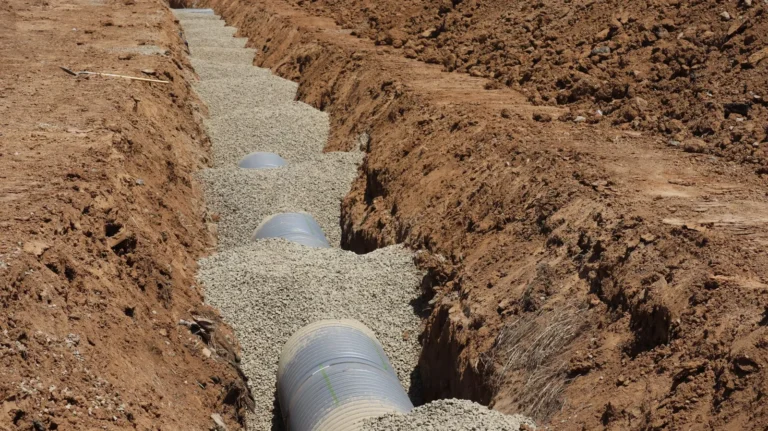
A French drain is a buried trench filled with gravel and a perforated pipe that collects groundwater and carries it downhill to a safe discharge point. It works on gravity, not pumps. Water seeps through the gravel, enters the pipe through the perforations, and flows away because the pipe is laid on a slight slope.
The system has four parts:
- The trench, dug 12 to 18 inches wide and 18 to 24 inches deep, on a 1% slope (about 1 inch of fall for every 8 feet of run).
- The perforated pipe, usually 4-inch corrugated HDPE, with the holes facing down so water rises up into it rather than soil washing in.
- Washed gravel, ¾-inch angular stone such as #57, which lets water move freely while keeping soil out.
- Nonwoven geotextile fabric, wrapped around the gravel like a burrito to stop silt from clogging the stone over time.
That fabric lining is the difference between a drain that works for decades and one that silts up. Skip it and fine soil eventually works its way into the pipe and plugs it.
Signs Your Yard Needs a French Drain
Not every wet spot needs a full French drain, but these are the situations where one usually pays off:
- Water stands in the same low spot for 24 hours or more after rain.
- The ground stays spongy and squishy underfoot well into dry weather.
- Your basement or crawl space is damp, or you see efflorescence on foundation walls.
- Downspouts dump water right against the house and it pools there.
- A retaining wall is bowing or showing water stains, which often means groundwater is trapped behind it. If the wall itself is failing, that’s a different fix — retaining wall repair costs are worth understanding before you dig.
If water is pooling at the base of a downspout only, a simple pipe extension to daylight may be enough. If the whole yard holds water, a French drain is the standard solution.
Photo by Marianna Zuzanna via Pexels
Tools and Materials You’ll Need
Here’s the full shopping list for a typical 50-foot run. Costs are 2025 retail prices from big-box stores.
| Item | What to Buy | Approx. Cost |
|---|---|---|
| Perforated pipe | 4-inch corrugated HDPE, 50 ft | $25–$60 |
| Gravel | ¾-inch washed #57 stone, ~1.5–2 cu yd | $60–$120 |
| Fabric | Nonwoven geotextile, 3 ft × 100 ft | $30–$60 |
| Pipe fittings | Couplers, end caps, downspout adapters | $15–$40 |
| Outlet | Pop-up emitter or grate + solid pipe | $20–$60 |
Tools: a trenching shovel or rented trencher, a line level and string for setting slope, a 2-foot level, a hand tamper, a wheelbarrow, a utility knife for cutting fabric, and a rake. A rented walk-behind trencher (about $100–$150 a day) turns a full day of hand digging into an hour.
Before you dig a single inch, call 811 to have underground utilities marked. It’s free in the US, and it’s the step that keeps a $1,000 weekend from becoming a five-figure repair bill.
How to Install a French Drain in Your Yard, Step by Step
This is the core of how to install a french drain in yard projects. Budget a full weekend for a 50- to 100-foot run if you’re digging by hand.
1. Plan the route and find your slope. The drain needs to start where water collects and end somewhere lower that can absorb or carry the water — a dry well, a drainage swale, or the street gutter. Use a line level and stakes to confirm at least 1 inch of fall per 8 feet. If your yard is dead flat, you may need to dig the trench deeper at the outlet end to create the slope.
2. Mark and dig the trench. Mark the edges with spray paint, keeping the trench 12 to 18 inches wide. Dig 18 to 24 inches deep and keep the bottom as smooth as you can. Pile the spoil on a tarp so it’s easy to backfill later.
3. Grade the bottom. Scrape the trench bottom with a shovel to hit your slope, then check it with a level every few feet. This is the step people rush, and it’s the one that determines whether the pipe drains or just holds water.
4. Line the trench with fabric. Lay the nonwoven geotextile so it covers the bottom and overlaps both sides by a foot or more. You’ll fold the excess over the top of the gravel at the end.
5. Add the first gravel layer. Pour 2 to 3 inches of #57 stone into the trench and rake it level, keeping your slope intact.
6. Lay the pipe. Set the perforated pipe on the gravel with the holes facing down. Connect sections with couplers, and cap the upstream end. If a downspout ties in, use a solid pipe and an adapter so leaves don’t enter the perforated section.
7. Cover with gravel and wrap. Add gravel until it’s about 2 to 3 inches below ground level, then fold the fabric over the top of the stone. The fabric should fully encase the gravel so soil can’t reach it.
8. Backfill and finish. Top with 2 to 3 inches of topsoil or, for a cleaner look near the house, 2 inches of pea gravel or sod. Compact lightly with a tamper and water it in.
9. Test it. Run a hose at the highest point and confirm water flows out the outlet. If it pools in the pipe, recheck your slope before you call the job done.
Photo by William Adams via Pexels
How Much Does a French Drain Cost?
For materials only, expect to spend $10 to $30 per linear foot on a DIY French drain, depending on whether you hand-dig or rent a trencher and whether you use HDPE or PVC. A 50-foot run typically lands between $500 and $1,500 for a DIY install.
Hiring a pro pushes the number to $25 to $50 per linear foot, or roughly $2,500 to $10,000 for a typical 50- to 100-foot residential job. The spread is wide because of access, depth, and whether the contractor adds a catch basin or sump pump. For a full breakdown of what drives the price, see our French drain cost per foot guide, and compare it with yard drainage cost per foot if you’re weighing alternatives like dry wells or channel drains.
Where a French drain becomes part of a larger job — say, drainage behind a new retaining wall — the wall itself usually dominates the budget. Retaining wall cost per linear foot gives you the numbers to plan the combined project.
Common French Drain Mistakes to Avoid
Most failed French drains trace back to one of these five errors:
- No slope. A pipe laid flat is just a buried pipe. Water sits in it and never leaves.
- Holes facing up. With the perforations on top, sediment drops straight into the pipe and clogs it. Holes go down.
- Skipping the fabric. Soil migrates into the gravel within a few years and the drain slowly dies.
- Using the wrong stone. Pea gravel and smooth river rock pack too tightly; you need angular, washed #57 stone.
- Dumping the outlet against the house. Routing the discharge next to your foundation just moves the problem three feet over.
French Drain Maintenance
A well-built French drain needs very little care. Twice a year — in spring and after leaf drop — do these quick checks:
- Clear the outlet or pop-up emitter of leaves, dirt, and grass clippings.
- Look for soft spots or depressions along the trench line that signal settling or a clog.
- Run a hose through any accessible inlet to confirm water still flows freely.
- Keep gutter guards and downspout strainers clean so debris never reaches the pipe.
If you notice water backing up at the outlet, snake the pipe with a drain auger or have a pro jet it clean before silt hardens. The fix is cheap early and expensive late.
Frequently Asked Questions
Do I need a permit to install a French drain?
Usually not for a shallow yard drain, but check with your city or county first. Many areas require a permit if the drain discharges to the street or a storm sewer, and some HOAs have their own rules.
How deep should a French drain be?
For lawn drainage, 18 to 24 inches is standard. Around a foundation, dig to just below the footing or slab level. The pipe should sit below the frost line only if the outlet is at risk of freezing shut.
Can a French drain be too deep?
Yes. Digging much below 24 inches buys you little for surface water, costs more in stone and labor, and can push the pipe below the outlet, which kills the slope you need.
How long does a French drain last?
A properly installed drain with fabric and washed stone lasts 20 to 30 years. Without fabric, expect to see performance drop within 3 to 5 years.
Is a French drain better than a dry well or channel drain?
They solve different problems. A French drain moves shallow groundwater along a line; a dry well holds water and lets it percolate in one spot; a channel drain catches surface runoff across a flat area like a patio. Many yards need more than one.
For a deeper look at how drainage choices stack up, This Old House explains French drain design in detail, and Family Handyman has a photo-heavy install walkthrough.
The Bottom Line
How to install a french drain in yard correctly comes down to four things: a real slope, perforations facing down, angular washed stone, and fabric wrapped all the way around. Get those right and the drain will quietly do its job for decades, drying out your lawn and protecting your foundation for a few hundred dollars in materials. Rush any one of them and you’ll be back with a shovel in a couple of years.
If the water in your yard is coming from a failing retaining wall, fix the wall before you spend on drainage — the two jobs often go together, and retaining wall installation costs will tell you what the full repair really involves. Otherwise, mark your utilities, rent the trencher, and get the gravel delivered. A dry yard is one weekend away.